
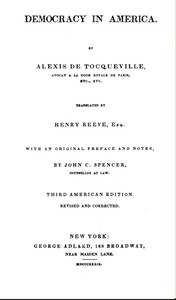
Democracy in America — Volume 1 by Alexis de Tocqueville
Okay, let's set the scene: It's 1831. A 26-year-old French nobleman, Alexis de Tocqueville, sails to America with his friend. Officially, they're there to study the prison system. Unofficially, Tocqueville is fascinated by this radical new experiment: a functioning democracy. For nine months, he travels from bustling cities to frontier towns, talking to everyone from presidents to farmers, taking notes on everything he sees.
The Story
There isn't a plot in the traditional sense. Instead, think of it as the ultimate travelogue mixed with a brilliant analysis. Tocqueville describes the American landscape, our manners, our laws, and most of all, our obsession with equality. He breaks down how local governments in New England towns work, why Americans join so many clubs and associations, and how our individualistic spirit is balanced by a need to work together. He's trying to solve a puzzle: How does this democracy actually function without collapsing into chaos? His answers form the backbone of the book.
Why You Should Read It
What stunned me is how current it feels. When Tocqueville writes about the 'omnipotence of the majority' and how public opinion can pressure everyone to think the same way, you can't help but think of Twitter mobs or cancel culture. His observations on American restlessness, our constant pursuit of material well-being, and even our national confidence ring true today. It’s less about dates and laws, and more about the American character. Reading him explain why we're so religious, yet so practical, or why we distrust aristocracy but create our own informal elites, is genuinely thrilling. You’ll find yourself nodding along, saying, 'Yes, that’s still us!'
Final Verdict
This isn't just for political science students. It's for any curious American who wants to know where our national personality came from. It's perfect for readers who enjoy big ideas, history that speaks to the present, and those 'aha!' moments when you see the roots of modern problems. Be warned: it's dense in places. Take it slow, a chapter at a time. But if you stick with it, you'll get one of the clearest, most insightful portraits of America ever written—by a Frenchman who saw us clearer than we often see ourselves.
Mary Miller
1 year agoRecommended.
Carol Wilson
10 months agoJust what I was looking for.
Donald Anderson
10 months agoSolid story.
Donald Jones
1 year agoI had low expectations initially, however the pacing is just right, keeping you engaged. Exceeded all my expectations.








Karen Anderson
10 months agoGreat reference material for my coursework.