
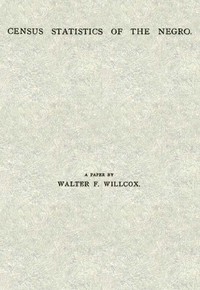
Census Statistics of the Negro: A Paper by Walter F. Willcox
This isn't a book with characters or a plot in the traditional sense. Instead, it's a primary source document—a paper presented by statistician Walter F. Willcox to the American Economic Association in 1904. Willcox was a leading figure in his field, and here he analyzes U.S. Census data about the Black population in the decades following the Civil War.
The Story
The 'story' is in the numbers and what people chose to do with them. Willcox lays out statistics on population growth, migration patterns, education, and occupations. He uses these figures to argue a specific point common among white academics of his era: that the social and economic conditions of Black Americans were primarily the result of inherent racial traits, not the crushing legacy of slavery and the violent suppression of Reconstruction. The paper is a snapshot of how data was being weaponized to support the racist policies of Jim Crow, all wrapped in the authoritative language of science and mathematics.
Why You Should Read It
You should read it not to agree with it, but to understand a powerful mechanism of history. It's chilling to see biased conclusions drawn from seemingly clean data. This paper shows how racism can hide in spreadsheets and percentages, making prejudice look rational. It forces you to ask critical questions about any statistic you see today. Who collected this? What were they trying to prove? What story isn't being told? Reading this is an active exercise in skepticism. It gives you a direct look at the intellectual architecture of segregation, built one graph at a time.
Final Verdict
This is for the curious reader who wants to go beyond history books and see the source material. It's perfect for anyone interested in the history of race, the sociology of knowledge, or critical data literacy. It's a tough, academic read, but a profoundly enlightening one. Think of it as a key to understanding how narratives of inequality are constructed, not with loud speeches, but with quiet numbers. It's a reminder that data has never been neutral.
Deborah Perez
1 year agoBased on the summary, I decided to read it and it provides a comprehensive overview perfect for everyone. A true masterpiece.
Betty Hernandez
1 year agoText is crisp, making it easy to focus.
Richard Hernandez
1 year agoThis is one of those stories where the clarity of the writing makes this accessible. Thanks for sharing this review.
Logan Hill
1 year agoVery helpful, thanks.






Anthony Sanchez
8 months agoThanks for the recommendation.